Love – not death – is Eternal
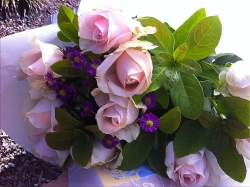 I stood amid the crowd of silent mourners in the hot white light of midday. We watch as the pallbearers carry the dark coffin covered by a massive bunch of red Valentine roses. Slowly the bearers move toward the sleek hearse and gently slide in the coffin. We watch with barely a rustle as the vehicle – all glass and silver – painstakingly eases past the church complex and slowly drives away.
Just a few days ago I attended the funeral of a valued friend. The tears flowed freely and hearts were moved as her husband, sister, friends and past colleagues gave tributes to a cherished woman’s unquenchable spirit, generous love, and strong faith. She was a loving daughter and sister, a creative and inspirational teacher, a caring friend, a devoted wife, and a dedicated,generous mother with a great heart. At a couple of months short of 47, her life was cut off far too soon. She will be greatly missed not least by her husband of 20 years and three precious children (12, 9 and 5 years of age).
My first memories of Anne Maree – almost a decade ago – was of a smiling, gracious woman who made me and my family feel welcome. Petite, vibrant, with infectious smile and keen blue eyes, she was full of life. Yet it is over the last two years that her indomitable spirit and unshakable faith really blazed bright. Almost exactly two years ago she was diagnosed with liver cancer. The medical team only expected her to live six months. Time and time again she surprised them – enduring chemotherapy with panache and flair, bouncing back from operations with a rapidity that totally astonished her doctors, remaining active and vibrant to the end, insisting on being involved in the day to day care of her children even as her body wasted away to a shadow. Rallying again and again and again. When most would have given up long ago, she clung to life with an unquenchable spirit not least to snatch a few more precious moments with her family. She had her down times but her faith in the love and power of God remained strong to the very end. Now, she is at peace, her battle over – as we who remain come to terms with her death.
Death – it is such a stark word, it does not roll smoothly over the tongue, it jars and shocks us. Yet the longer we live, the less we can avoid it’s dark reality. I’ve been to more than a few funerals over the years – of friends, family and colleagues – and I have mourned the death of many more.
I think my first funeral was of the father of a close friend. It was a muted affair in a simple crematorium chapel. His life was marred by the break down of relationships and a losing battle with the bottle, yet his children gave heartfelt appreciation of his love for them over the years. Some time after this was the funeral of a fellow bible college student, a beautiful young Maori woman in the middle of her studies. I can still vividly recall her bubbly personality, her glossy curtain of black hair, dark lively eyes and warm smile. She had a dynamic faith and a strong calling to missionary work. I remember the evening over coffee when she told me she felt unusually, bone sapping tired, should she be worried? She looked pale. I suggested she see her doctor for tests. A few days later she was diagnosed with Leukaemia – a type that at that time had over 90% chance of cure. Yet a couple of months later, following chemotherapy, she developed a rampant infection and died. She was just 30 years old. Her grieving family flew over from New Zealand and the church was crowded with fellow students, teachers, friends and family wondering over a promising life cut short.
Lives cut short. Yet even when lives are long, death jars us. For me, the year that brought this home the most was 2002. I sometimes joked that this was my year of “five funerals and a wedding” – though it was no joke. In all, eight people I knew and had significant connections died (including four family members)- while one close friend married a quiet, gentle man (in January 2003) – a rare joyful celebration in the midst of the bitter sweet and the sad.
The funeral that hit me the hardest that year was that of my youngest brother. He was 35 years old. A life cut short after a losing the battle with depression and despair.  I can remember as a seven year old carrying him on my hip with great love and pride. His baby-blond curls, bight blue eyes and trusting smile won our hearts. My brothers and I doted on him. Always a little eccentric as a child, he grew into a gentle, troubled man – brilliant at maths, a great love for fantasy and science fiction but struggling with the intricacies of social interactions and a hidden past of bullying. He found a mixed haven in the Air Force but left it in the middle of a recession and then struggled to find steady employment. Always gentle, he turned his anger inward spiralling to a place where the love of his family and God seemed cut off from to him. Yet even in the midst of despair God’s love reached out. I can still vividly remember the piercing, paralyzing sadness that descended like a pall as I listened to my mother voice on the phone, telling me that they had found his body in his newly rented flat. Over the days and months afterwards I remembered the word of the wise woman of Tekoa to King David of Israel “Like water spilled on the ground, which cannot be recovered, so we must die.” (2 Samuel 14:14a NIV) Once the jar of water hits the hard ground and shatters, the water can not be gathered up or put back. It spreads out in silver flood seeping into the cracks and crevices and evaporating into thin air. In real life, there is a finality about death. It disrupts and jars us.
When faced with the starkness and disruption of the death of his close friend Lazarus of Bethany – Jesus wept. His sisters had sent him a message several days ago that their brother was seriously ill but Jesus had delayed his journey from Galilee to Bethany. The hostility of the religious leaders was at boiling point, so it was dangerous for him to be near Jerusalem (and indeed in a few weeks Jesus would be arrested, tried and killed.) Yet that is not why he delayed. By the time Jesus arrived at the house, his friend had been dead and buried 4 days. First Lazarus’ sister Martha, then Mary and then the crowd reproached him. If Jesus had come sooner he surely would have been able to heal Lazarus. Now he was dead. The jar of water had smashed to the ground, the point of no return had been reached. Jesus looked at the tear streaked faces of his dear friends, capable Martha and gentle Mary, he saw the weeping mourners, he thought of his friend’s body decaying in the tomb and he wept at the reality, starkness, the stink of death. Jesus was often moved to compassion by the crowds that milled around him, by the poor, the sick, the outcasts that looked to him for healing and acceptance. Yet it is recorded that he wept on only two occasions – when he looked at Jerusalem and foresaw its bloody destruction (which eventuated in AD 70), and when he came to the close friends and family sitting shiva for his friend Lazarus. Death is a stark reality which in the end we all face. Yet, in the Story of God (the Bible), the sadness and disruption of death is not how things were meant to be, not how things will always be.
As final as death seems, it is part of the Christian faith that it is not the end. Death will not intimidate and bully us forever. Even as the tears streamed down his face, Jesus already knew – had known in Galilee – what he was now about to do. “Take away the stone (from the entrance to the grave)” he commands. Martha, ever practical protests, “He’s been dead four days, Teacher. The smell …!” But because he insists they do what he directs, pushing the heavy stone from the dark opening of the tomb. “Lazarus come forth” he commands. The incredible happens, a dead decomposing body stands up, is restored to life and personality and walks out of the tomb. Lazarus has been brought back from the dead to the amazement and disbelief of those who see it with their own eyes and those who hear about it.
Yet, as amazing as this was, it was just an appetizer of what God, in Jesus, has planned. For Lazarus, how many years he may have lived after this event, would eventually die and his body would once more be laid in the grave, a temporary reprieve from the disruption of death.  However, the biblical witnesses claims that though Jesus was brutally murdered on the cross and laid in the tomb for three days – he was raised by the power of God to a new kind of life, a life in which death and decay no longer has a place. A resurrection life which he offers to us, if we but accept it. As he says to Martha “I am the resurrection and the life. The one who believes in me will live, even though they die; and whoever lives by believing in me will never die. Do you believe this?” (John 11:25-26)
Do you believe this? Of course many, many people are sceptical of these reports and claims. Possibly you are too. You might not believe in miracles or a God who intervenes in the course of ordinary life, into nature and history. You may not believe in an after-life. You may be sceptical of the gospel reports of Jesus being raised from the dead or his divine nature. You might doubt the veracity and accuracy of the biblical accounts. I can understand this – though after much investigation, thought and experience, I am convinced that of these things are indeed true. And not just I, but many others as well. So I entreat you not to dismiss such things out of hand.
Some five years before the year of funerals and a wedding, we had participated in the funeral of one of our pastors. Stephanie was a mother of two preteens, a devoted wife and a caring pastor. Even as she underwent cancer treatment, her undying faith, positive spirit, listening ear and empathetic concern for others impacted strongly on her doctors, nurses and fellow patients. Perhaps what was most moving of all was the audiovisual recording played during her funeral of her sermon on the reality of the resurrection and anticipation of the joy of being in God’s loving presence, which she had given a year previously, just months before the discovery of cancer.
Others too have, in the severest tests of faith, have held on to these things as true. Another friend struck down by cancer in her forties insisted on purple balloons to festively adorn the church and asked that her strong affirmation of Jesus was the crucial centre point of history be read out at her funeral. I think of my Aunt Kath who lived to the age of 89. As a young woman she chose singleness so that she could serve Jesus with greater dedication. To me she was like a second mother and a definitely a strong mentor, the living hub of our extended family, still writing regularly and sending birthday cards not only to siblings and their spouses, not only to numerous nieces and nephews, but to their children and grandchildren. Just a year before her death she sent a small baby doll clothed in a hand knitted pink outfit from my (then) two year old daughter. She was a quiet friend in need to the people of her church and neighbourhood, a faithful and sacrificial supporter of missions, a knitter of garments and blankets, a great cook of old fashioned goodies with a pantry full of delicious home made jams and preserves and the unstinting provider of a welcoming cup of tea for any and all who would drop in for a visit and a chat. I think of another fellow Bible College student who drowned saving the life of his and another family’s children caught in a treacherous rip in a lake in faraway Pakistan. In the midst of tragedy, like Anne Marie, theirs was a triumphant living faith not dimmed by the abruptness and disruption of death. I can think of more examples of people all personally known to me with this rugged, tempered faith – men and women; old, middle aged and young; formally educated and/or educated in the school of hard knocks; some having completed the course of this life and many others still running the race.
One of the most famous followers of Jesus, Paul of Tarsus went through incredible hardship following his risen master – beatings, stonings, ship wreck, snake bite, ridicule and slander, sleepless nights, poverty, hunger, imprisonments and finally execution. He writes to the church at Rome toward the end of his life,
“Christ Jesus died for us, but that is not all. He was also raised from death. And now he is at God’s right side, speaking to him for us. Can anything separate us from Christ’s love? Can trouble or problems or persecution separate us from his love? If we have no food or clothes or face danger or even death, will that separate us from his love? … I am sure that nothing can separate us from God’s love — not death, life, angels, or ruling spirits. I am sure that nothing now, nothing in the future, no powers, nothing above us or nothing below us — nothing in the whole created world — will ever be able to separate us from the love God has shown us in Christ Jesus our Lord.” (Romans 8:34, 35, 38, 39 ERV)
Nothing can separate us from the love of God – not even death because in his resurrection, Jesus defeated death. Earlier Paul had said to the rather fractious bunch of Jesus followers at Corinth, “Love is eternal … Meanwhile these three remain: faith, hope, and love; and the greatest of these is love.” (1 Corinthians 13:8,13 GNT)
Just a couple of days after Valentine’s Day – a brave husband gave a inspiring tribute to the love, courage and faith of his cherished wife – and to God’s unfailingly love. Among those who listened, tears flowed freely, raining down in grief and loss. Yet as his words resounded in the packed auditorium, as other voices were lifted in meaning-packed songs and tribute, as luminous photos flashed across the screens our hearts were stirred. Faith, hope and love took form and began to soar through the rain.
Love – not death – is eternal.
Jenny

In Clay Jars
 Having been reminded of the Story of The Little Tea Cup recently, I was also reminded of a poem I wrote for my youngest brother. At the time he was going through a losing battle with depression. It was so hard to watch him as he plunged again and again to the abyss of despair – unable to feel the love of his family or God, unable to hold on to hope, to see a brighter future without the severe emotional pain he felt or to take hold of the arms streteched out to him to help and comfort him. After each harrowing down he would have renewed hope and brave resolutions but before long the slide towards despair would begin again. I wrote the poem a year before he died – as my heart ached for him – and read it out at his funeral. I am convinced that in the end God reached down to him and enfolded in his great forgiving love & finally he was able to accept it. This poem is written for him – and for myself who is also a clay jar in the maker’s loving hands. I am not really a poet but I hope this poem might speak to you as it spoke to me.
Jenny
In Clay Jars
This treasure in clay jars God holds,
Clay that is cracked, dirtied, chipped, abused,
Clay that hides the treasure
God enfolds.
So often we see but the outward shell,
Judge others and ourselves by imperfections which abound,
Turn our backs on treasure
God knows well.
His likeness, His image he placed
In us, when from clay and living breath Adam He made.
On His light, community and love
Are our natures based.
We turn our backs on Him, our source of life.
In arrogance and pride we snatch our own way, find our own light,
And lose our path in despair,
In darkness and in strife.
Yet of the treasure he placed within He never loses sight.
He took our clay, broken on a cross,
He took our darkness and strife and with the Father,
Made us right.
Transformed from the grave, God’s Son declared,
He gives new life to our clay. By the Spirit of fire within
Fills cracks, cleans and reveals,
Our treasure shared.
This treasure in clay jars God holds,
Clay that one day will be transformed and translated
To eternal realms, to reveal the treasure,
Father, Son and Spirit enfolds.
Jeanette (Jenny) O’Hagan 2001 (Written for & recited in memory of my brother Chris 1966-2002)
The Parable of the Little Tea Cup
 I was reminded about this story of a little tea cup while talking to a good friend going through a really tough time over the last year or more. It is something my mother passed on in a email a little while ago while I was having tough times over a prolonged period of time. At the time it reminded me of the refiners fire. As Simon Peter puts it :
“Your faith will be like gold that has been tested in a fire. And these trials will prove that your faith is worth much more than gold that can be destroyed. They will show that you will be given praise and honor and glory when Jesus Christ returns.” 1 Peter 1:& CEV
My first thought at the time I read this modern day parable was that the fire was just bringing the dross to the surface ‘cos I wasn’t reacting all that well, feeling very downhearted and discouraged and sometimes angry. It took several weeks and months of reflection to realise that during the refining process, the dross seperates from the pure metal and rises to the surface so that it can be skimmed off and removed. Refining is not a gentle or neat process. God was bringing the dross to the surface of my character to remove it. It’s easy to be nice when things are going well but with God’s grace we can “shine” even in the midst of adversity. The divine potter has a great love for each of us – it may be tough love sometimes and at others the tender love – but it is always unfailing and wise.
Jenny
The Story of the Little Tea Cup
There was a couple who took a trip to England to shop in a beautiful antique store to celebrate their 25th wedding anniversary. They both liked antiques and pottery, and especially teacups. Spotting an exceptional cup, they asked “May we see that? We’ve never seen a cup quite so beautiful.”
As the lady handed it to them, the teacup suddenly spoke, “You don’t understand. I have not always been a teacup. There was a time when I was just a lump of red clay. My master took me and rolled me pounded and patted me over and over and I yelled out, ‘Don’t do that. I don’t like it! Leave me alone.’ But he only smiled, and gently said; ‘Not yet!’”
“Then. WHAM! I was placed on a spinning wheel and suddenly I was spun around and around and around. ‘Stop it! I’m getting so dizzy! I’m going to be sick,’ I screamed. But the master only nodded and said, quietly; ‘Not yet.’
“He spun me and poked and prodded and bent me out of shape to suit himself and then… Then he put me in the oven. I never felt such heat. I yelled and knocked and pounded at the door. Help! Get me out of here! I could see him through the opening and I could read his lips as he shook his head from side to side, ‘Not yet’.”
“When I thought I couldn’t bear it another minute, the door opened. He carefully took me out and put me on the shelf, and I began to cool. Oh, that felt so good! Ah, this is much better, I thought. But, after I cooled he picked me up and he brushed and painted me all over. The fumes were horrible. I thought I would gag. ‘Oh, please; Stop it, Stop it!’ I cried. He only shook his head and said. ‘Not yet!’.”
“Then suddenly he put me back in to the oven. Only it was not like the first one. This was twice as hot and I just knew I would suffocate. I begged. I pleaded. I screamed. I cried. I was convinced I would never make it. I was ready to give up. Just then the door opened and he took me out and again placed me on the shelf, where I cooled and waited – and waited, wondering “What’s he going to do to me next?
An hour later he handed me a mirror and said ‘Look at yourself.’” “And I did. I said, ‘That’s not me; that couldn’t be me. It’s beautiful. I’m beautiful!’
Quietly he spoke: ‘I want you to remember, then,’ he said, ‘I know it hurt to be rolled and pounded and patted, but had I just left you alone, you’d have dried up. I know it made you dizzy to spin around on the wheel, but if I had stopped, you would have crumbled. I know it hurt and it was hot and disagreeable in the oven, but if I hadn’t put you there, you would have cracked.
I know the fumes were bad when I brushed and painted you all over, but if I hadn’t done that, you never would have hardened. You would not have had any color in your life. If I hadn’t put you back in that second oven, you wouldn’t have survived for long because the hardness would not have held. Now you are a finished product. Now you are what I had in mind when I first began with you.”
The moral of this story is this: God knows what He’s doing for each of us. He is the potter, and we are His clay. He will mold us and make us, and expose us to just enough pressures of just the right kinds that we may be made into a flawless piece of work to fulfill His good, pleasing and perfect will.
So when life seems hard, and you are being pounded and patted and pushed almost beyond endurance; when your world seems to be spinning out of control; when you feel like you are in a fiery furnace of trials; when life seems to “stink”, try this….
Brew a cup of your favorite tea in your prettiest teacup, sit down and think on this story and then, have a little talk with the Potter.
– Author Unknown
Other related posts:
Where is God in the midst of natural diasters? http://jennysthread.com/building-on-bedrock/
In Clay Jars http://jennysthread.com/in-clay-jars/
Building on Bedrock
In 2011, a great many Australians have faced the full force of nature’s fury and many are still picking up the pieces. Across this normally dry continent we have faced searing fires (in the west) and (in east) incessant rain, raging floods, summer storms and powerful cyclonic winds. It was not so long ago that dams across the nation were almost empty and drought ate away the life blood of rural communities. This “sun burnt country” is truly the land of “flooding rains and sun burnt plains”. Even as Australians continue the hard grind of rebuilding, hampered in many cases by further rains and political controversy, our Kiwi cousins across the Tasman faced heartbreaking loss of life, homes and businesses as Christchuch has been devastatingly shattered by a second and then a third major earthquake. It is not that these are the worst disasters that have shaken our planet – as the earthquake and Tsunami in Japan and major flooding in in Pakistan, the USA and Thailand reminds us. Many disasters have taken more lives while each day thousands to hundreds of thousands die largely unnoticed in our neighbourhoods and across the world due to road accidents, suicide, preventable diseases, pestilence, grinding poverty, famine and war. Yet no matter how ubiquitous disaster is, being participants in such extreme events is bound to be disturbing.
Like the passengers and crew of the Titanic, we can so easily be lulled into a sense of security based on our relatively comfortable lives and our belief in human ingenuity and invention. And it is truly amazing what humans have achieved in building cities, taming nature, exploring the world about them and pushing the boundaries of creativity and knowledge. Yet disasters, especially natural disasters, have the power to shake us out of our normal routines and smug complacency. When nature strikes in our own back yard, when we ourselves are caught up in its furious diatribe or we see our family and friends directly affected, its impact goes deeper and darker. We suddenly feel small and powerless in the face of nature’s fury. Our lives become hostage to our preparedness, to the community’s response, to freak circumstances and to incredible forces beyond our control. What took years to build – the empires, homes and lives; the things we gather and things we cherish are destroyed in an instant. Lives and livelihoods are overwhelmed. Even those on the fringes of disaster are shocked. Numbed, they watch family, friends, neighbours and fellow citizens caught up in nature’s indifferent might.
Natural disasters undermine our modern belief that we control our lives, that we can build our future to be whatever we want it to be, that we live in a basically stable, ordered and fair world.
As the flood waters begin to recede, the winds abate, the earth stop shaking and the sun begins to shine, we humans take stock and the questioning begins. Why did this happen? Is anyone to blame? What could have been done to prepare us for this moment that was not done? What could have reduced the toll on buildings and lives? How and where can we rebuild? And, on a more existential level, how do we cope with our feelings of uncertainty and danger? What really matters to us? Why are we here?
These are not easy questions with simple pat answers yet they go to the very heart of what it means to be human – to how we live our lives in this place – this beautiful, amazing, lively, restless blue-green ball spinning around a fiery sun in the vastness of star spangled space. Wrestling with these pressing questions in the context of recent events, we can answer them on at least two levels: the practical and the existential or more simply put on the human and the spiritual.
On a practical level we ask to what extent are humans responsible?
In the midst of overwhelming natural disaster, humans often feel swept away by the chaotic unpredictability of the moment. Yet the fact remains that we do have the power to mitigate or (in some cases) to prevent the extent of the destruction. We are not completely powerless in the face of disaster. There are aspects over which we have some control, even responsibility.
We choose to live or to remain in areas prone to natural disaster. There are good reasons for this such as access to resources, trade, water, land, community and strong historical, ancestral and/or spiritual ties to the land. Even if the task of uprooting and resettling was easy or possible (which it often is not), where can we go to escape the drastic disruptions and powerful forces of this restless planet? Australians would be hard pressed to find a place to live that could not be potentially threatened by storms, floods, cyclones, drought or bushfires as the beginning of this year have demonstrated. On a minor scale we can avoid building on obviously flood prone areas, or beach front properties exposed to the full force of cyclonic winds or amidst bush land at risk of wild fires. In the end, however, we have to choose our “poison” – the risks we are prepared to live with to build the lives to which we aspire.
Knowing the dangers we can prepare for them at an individual and community level. This includes long range planning, building codes and practices, water management, emergency management plans, effective warning systems and communication, boarding up and bunkering down. In the event of disaster we can choose to respond – to help each other, to act courageously, generously and with compassion or to be indifferent to or even exploitive of our neighbours’ plight. Finally, we need to acknowledge that human activity – at a local and at a global level – impacts on the world we live in. Deforestation, global warming and climate change all can directly affect or exacerbate such events.
So there are things we can do that can mitigate and protect us against the full force and destruction of even in once in a century events. But two facts remain. Firstly, people being what they (or we) are often don‘t prepare adequately, may cut corners and may even exploit the situation for perceived gain (whether by corrupt skimping on building codes or taking advantage of those still dazed by the disaster’s impact). Secondly, even with the best foresight, communications, planning and timely action, lives may be lost, buildings and infrastructure destroyed and livelihoods disrupted. Nature is too powerful to be completely tamed and it has a way of throwing curve balls at us (like the horrific “inland tsunami” that devastated Grantham and other communities in the Lockyer Valley). Essentially, it comes down to the fact that we live on an unstable and violent planet that often takes the human life it nurtures.
On an existential or spiritual level, why is the world we live in unstable?
Which brings me to the existential question of why? Why do we live in a paradoxical world that gives promise of life and beauty and then snatches it away in one chaotic, seemingly senseless instant? There are many possible answers and no consensus on this unsettling question.
The Materialist response
The materialist answers that, as the material universe is all there is, there is no ultimate answer to this question. This amazing, complex and beautiful world we live in, with all its wonders, is ultimately the result of deep time and blind chance. The universe blasted into existence from a miniscule quantum singularity for unknown reasons and by an unknown cause.  Over vast eons of time, it has expanded and evolved through time and chance from the simplest components into increasingly complex entities (stars, galaxies, planets, microorganisms, simple multi-cellular organisms, complex plants and animals, Homo sapiens, an integrated and interacting biosphere, complex interacting cultures etc). One day in the future it will either collapse back into a singularity or more probably continue to expand until all useful heat and life has been irretrievably extinguished. While even the simplest human being has a brain of amazing complexity, we are here by mere chance, life is ephemeral and the only value and purpose it can have is those we choose to give it. We live on an uneasy, violent planet because of the physical constants of the universe – humans are a product and victims of this world. At best we may- in time and for a time – create our own environment and gain greater levels of mastery over nature through science and technology. At worst we should enjoy life while we can (“eat, drink and be merry”) for tomorrow we die.
While there is a grandeur to this vision (as C S Lewis noted), I find it profoundly unsatisfying and full of un-provable assertions and unsatisfying presuppositions. The materialist boldly claims that there is no other reality apart from the material because they insist that reality can only be known by means of the material – thus begging the question. They cannot really explain why there is a universe, why this universe is ordered (following laws of physics), the origin and source of consciousness and reason, the origin of complexity and beauty particularly as it obtains to the origin of life and the origin or nature of the stuff that makes us human – our love for beauty, music, art, laughter and humour, our creativity, our sense that the world should be fair, our need for love and purpose, our longing for something beyond our material existence.
The Eastern Spiritualist response
While the West in recent centuries has discounted the validity of anything outside or above the natural (the supernatural), the East has traditionally tended to discount the material. Hinduism and Buddhism inherit a similar world view – that all life is caught up in an interminable cycle of birth and rebirth fueled the law of karma. So at one level, the events that happen to us both good and bad are direct consequences to our actions in the our past lives both good and bad. Karma is inexorable – for every past good action is rewarded and every past bad action is punished in exact measure by an impersonal, intransigent, uncaring law. At this level, the grief and distress caused by natural disasters as well as more every day unfortunate events are a result of our past actions in past unremembered lives – we get what we deserve. On another level, most streams of Hinduism and Buddhism claim that the material space-time world we live is an illusion and that the only reality is spiritual - an impersonal Being (Brahman) or existence (Nirvana) – in which the illusion of personal identity is erased. Thus either the illusion of personal separateness (Hinduism) or the hook of desire for wealth, love, safety, health, significance, identity (Buddhism) imprisons our consciousness in this world of suffering. Hinduism advocates different spiritual techniques and different paths (of devotion, duty or denial) to escape illusion while Buddhism counsels mindfulness and the giving up of all desire and attachment to this life. At this level concepts of “right” and “wrong”, “good” or “bad” are merely a matter of perspective, two realities in constant and unending tension and dynamic balance with each other.
Elements of this view of reality do resonate with me – in particular that it is often our desires that cause us pain and detachment protects us from it. The concept of karma is rather neat (everyone gets what they deserve, disasters happen because of past moral failures), yet it is inexorable, inescapable, unpredictable and ultimately unexplainable (why should an impersonal universe be moral especially if ultimately good and evil have no intrinsic meaning?). The concept of karma may ease my feelings when observing others suffer (even fostering a lack of compassion or justifying gross inequities as in the caste system in India) but it gives little comfort to those overwhelmed with disaster to believe it is the result of something done in countless past but unremembered lives.
While I might well seek to detach myself from this world to avoid the emotional impact of suffering, at a more profound level, such a strategy fails to explain to me the awesome beauty and joy of life, the profound need humans have for the personal, the possibility of forgiveness and grace. 
Even living in the privileged west, (my) life is often filled with difficulties, disillusionment, roadblocks and the painful loss of cherished loved ones. However, I cannot escape the conviction that it is when I feel the most deeply, when I love the most sacrificially, when I care the most strongly, I am the most human and the most alive. Gautama Buddha supposedly said that it is harder for women to be find enlightenment (Nirvana) because giving birth ties them more strongly to this life of illusion. Yet for me, being a mother has been one of the most profound and one of the most challenging experiences of my life that, despite the difficulties, has given me a much deeper understanding of myself, of love, joy, grace and life and, I believe, of the heart and reality of God.
Alternative Spiritualist Response
New Age or Alternative spiritualities seek to combine the wisdom of the east and indigenous cultures with Western worldview in a search for personal fulfillment and wholeness. It is a diffuse, eclectic approach that tends to cherry pick techniques (meditation, crystals, reiki, astrology etc), concepts (reincarnation, karma), symbols (rainbow, stars) and values (environmentalism, nonviolence) to suit the individual. Its followers give various explanations to natural disasters and painful events from harmful human activity that exploits the environment, to environmental disharmony, to the planet (Gaia) righting the balance, to karma, to a solipsistic idea of scripting (that “I” script my life to happen according to my unconscious spiritual needs). Yet it’s lack of intellectual rigueur, its emphasis on personal preference and its almost fanatical focus on personal fulfillment, its tendency to see suffering as the fault of the sufferer do not appeal to me.
Theistic Response
Theism (primarily represented by the faiths that more or less draw from the Bible) validates both spiritual and physical reality. The theist believes that an eternal, infinite, personal, loving God created both the spiritual world and the material, finite space-time cosmos and the beings that inhabit it. He creates the earth as a good, fruitful and bountiful environment and he creates humanity to be guardians over the creation (to care for it and to benefit from it). Yet (at the dawn of time) there is both a spiritual and human rebellion against God’s rightful rule which puts the whole world out of kilter with a good God. In deciding to trust in their own wisdom and will for the future, the relationship with God was fractured. It is this fracture in reality that explains the presence of evil and suffering – both on a human and on a natural level.
The story, however, does not end there as the Book unfolds God’s plan to restore both humanity and creation back into relationship with him – to restore and even go beyond its original harmony and beauty. For Christians (unlike other people of the Book), Jesus of Nazareth as God incarnate is at the centre of this plan of restoration and it is through faith in him that we can become part of the story. However, we are still in the middle of that journey so we still live in a world out of kilter with God.
Thus the Christian response to natural disaster and suffering in this life is complex and nuanced. Natural disasters result from a world in rebellion, they can be seen as punishment for wrongdoing yet there is not always a direct relationship between evil and disaster. Wrong doers often apparently go unpunished while the innocent suffer. The worst things sometimes happen to the best people. And at times bad things just happen. This is in part because actions can set in motion a chain of events of wide ranging effect. Rather than constantly intervening (especially when his help is neither sought nor appreciated), God often allows events to take their course (within certain prescribed limits). Eventually, all wrong doing will be dealt with given time and eternity.
However, the God of Abraham, Moses and Jesus is not indifferent or removed from our plight. He listens to those who turn to him for help and helps at times subtly and, at other times, in astounding ways. More than this, he works in the middle of disastrous situations and redeems them for good as he did with the death of Jesus, God-Son, on the cross. If we give him our lives, he takes all the elements of our life and like a master weaver expertly combines the light and dark threads to make a glorious tapestry (though his design will not be completely understood until the pattern is finished). Nor does he remain aloof to human suffering and pain. Rather, he enters into our pain, walks with us and carries us through the angst and anguish. This is seem most supremely in the incarnation, when the Son (eternal God) genuinely entered the human condition by becoming a human being, living a life of goodness and controversy and willingly enduring one of the most painful and humiliating deaths ever invented so that we might be restored to a relationship with the triune God.
The Christian answer to natural disaster and human suffering is not without its tensions and its imponderables. There have been times in my life even in recent times when it has been sorely put to the test. Yet it has sustained me and continues to sustain and steer me through pain and anguish. It provides both comforts and challenges, gives serenity and stimulus to act. Life is not without meaning or responsibility, nor is it fatalistic. And by no means is it just about me and my spiritual fulfilment. Rather it is an adventure, in which we partner with God to make a difference, to act compassionately and to live in boldly.
 Jesus challenges us to build our lives on the bedrock of faith – in God’s goodness and love and his plan to of restoration of a fractured world through the life, death and resurrection of his Son. He says, “I’ll show what it’s like when someone comes to me, hears my words, and puts them into practice. It’s like a person building a house by digging deep and laying the foundation on bedrock. When the flood came, the rising water smashed against that house, but the water couldn’t shake the house because it was well built.” Luke 6:47-48 CEB
No matter what the force of the wind and waves, no matter how hot the fire, not even death itself is a match for the Creator of more than a hundred billion galaxies, of the vastness of space and of time itself.
Jenny
Flooding Rains

The rain was relentless. For a couple of weeks it had poured out of the sky with only intermittent breaks. Every few days the sun half-heartedly peeked through the clouds for an hour or so. It was no surprise when on Monday flood warnings for the Bremer and Brisbane River were issued for Wednesday and Thursday. Over the period of a couple of days and despite previous releases Wivenhoe dam had filled to almost double its capacity.
At 1:30pm Monday 11 January, a freak flash flood swept through the centre of Toowoomba (population 128,600) perched on the crest of the Great Dividing Range, roaring through the main street, sweeping cars, trucks, debris and people away. Some managed to cling to poles, car roofs, and trees; most were rescued but a mother and her young son were not. The wall of water continued eastward, descending down the range and devastating many small hamlets and farms in Lockyer Valley over the next few hours. The small town of Grantham (population 360) was particularly hard hit when – with no or minimal warning – cars, trucks, houses, boats, small planes and people swept helplessly away leaving only one street of houses standing, many dead and with many still missing. Overall, the “insland tsunami” took 21 lives and over 100 families were significantly affected by flood waters in Toowoomba, the Lockyer Valley and the Condamine region.
The combined waters from the Lockyer Valley, necessary flow releases from the Wivenhoe dam and Bremer river and had swollen the Brisbane river into red, muddy, raging torrent. By Wednesday night a third of Ipswich (population 155,000) was under water as the Bremer overflowed its banks with homes and business flooded and many more cut off by flood water and/or without electricity. Brisbane (population 2,000,000) was next. While the waters did not reach the worst case scenario(4.46 m rather than 5.5m), low lying areas close to the Brisbane River, Breakfast Creek and the Pine river were engulfed in the steady rise of flood waters including much of the Central Business District. Homes, businesses, the Rocklea markets, the iconic Suncorp Stadium (Lang Park), schools, parks, pools and recreation areas were swamped. Upstream the Moggil Ferry broke one of its two tow lines threatening to torpedo down the river. A picturesque floating Restaurant, the River walkway (stretching along the vibrant bank of the river), most of the city’s Ferry cat terminals and platoons as well as many private platoons and boats were submerged, damaged and in many cases swept away. In total over 20,000 thousand homes were inundated, 80,000 homes lost power (and another 30,000 in Ipswich), 35 suburbs affected and at least four suburbs totally cut off for three days. The Central Business District CBD (or City) was virtually deserted with many skyscrapers flooded, power turned off to a large area and all buses and most trains into the city cancelled. Startling images of flooded streets, a raging debris choked river, freeways turned into rivers, families and even cows stranded on roofs, individuals navigating in tinnies, canoes and even spas through once quiet leafy suburbs, a frog perched on a swimming snake’s back and a fox on a floating tyre in the midst of swirling waters flooded the TV and computer screens of a stunned nation.
It is 37 years since Brisbane has experienced rainfall and flooding of this magnitude. And while the flood peaked lower in most areas, many more homes, businesses and infrastructure were affected than in 1974. However this disaster was not confined to the southeast of Queensland. During the 2010/2011 Queensland Floods over three quarters of the State was declared a diaster area. Even before Toowoomba, the Lockyer Valley, Ipswich and flooded over half the area of Queensland ( or about 1,000,000 square kilometres – the size of France and Germany combined) had been been flooded with many hamlets and towns completely cut off and with others having only just finished cleaning up the thick mud and debris from homes and businesses when they were flooded again and then again. Over 80 towns were significantly affected by flooding across Queensland. To the south, in northern NSW the Grafton and the Clarence River valley was also experiencing major floods and in a few short days after the flood in Brisbane and Ipswich, large areas of Victoria were inundated (many like the area around Rochester for the second time in months). Within weeks the North of Queensland was hit by two cyclones, including the devastating Yasi. Ironically, on the other side of Australia, Perth in Western Australia was experiencing a dry, burning heat with fierce home destroying bushfires lit deliberately. Overall, in the summer floods of December 2010/January 2011 35 people died, countless livestock and wild life perished or displaced, with a massive economic impact (estimated at over a billion dollars). Nor has the flooding and its inpact ended with many people dislocated and/or living in temporary accomodation, roads and infrastructure still being repaired or replaced and many Queensland coal mines remaining closed due to flooding. The scale of the devastation is hard to imagine yet despite its extent loss of life was relatively minimal (compared to the 1,836 deaths with Katrina in 2005 which affected 90,000 square miles or 233,000 square kilometers or over 1,800 deaths in the 2010 Pakistan Floods affecting approximately 796,095 square kilometres).
Yet this is not just a tale of disaster, devastation, grief and horror. It is also a story of rescue, bravery, resilience, mateship, compassion and practical help. There are in fact too many of these stories to relate though some stick strongly in my memory. In Toowoomba, a brave young boy clinging on the roof of the car urged the rescuers to rescue his younger brother first. His brother was saved but minutes later a wave of water swept him and his mother away. At Murphy’s Creek a brother helpls saves his sister by pushing her into into the roof space of their house though he doesn’t have enough time to save his parents. In Grantham, seeing a wall of water bearing down on them two brothers evacuated both their families and neighbours, transferring from 4WD to boat to get them to high ground before going back in the boat to pluck people from the raging waters. At Moggil the captain of the ferry spent a turbulent night on board his stricken vessel to ensure it did not careen down the river causing more damage in its wake. Down the river a tug boat captain risked his life to steer sections of the broken River Walkway away from the threatened pylons of the bridge.
On Tuesday and Wednesday as the Brisbane and Bremer Rivers began rising rapidly, many volunteers turned up to help sandbag homes and business, to move people’s belongings and furniture and to help evacuate areas in the hours before the flood waters arrived. On Wednesday evening, Kevin Rudd, Australia’s Foreign Minister and former Prime Minister, waded through knee deep, brown murky water blocks away from his own house, warning people it was time to go and helping carry suitcases of belongings out of the flooded area. During the crisis Queensland Premier Anna Bligh, Brisbane Mayor Campbell Newman and Ipswich Mayor Paul Pisasale worked tirelessly to keep people informed and the flood response coordinated. In the days immediately following the flood, as the waters slowly receded, so many people turned up to help with the clean up that roads were gridlocked. Christened the Mud Army over 55,000 volunteers (neighbours, community groups, churches, family, friends, strangers), army and emergency services (SES and fire brigade) all pitched in to help clear the mass of muddy debris, once valued possessions, and metres deep thick, smelly, sticky mud that covered everything. Our local church sent out a number of teams to help, our thrift shop donating clothes and other necessities to and taking up special offering for flood affected people, a church from the Gold Coast turned up with a sausage sizzle to help feed the army of volunteers in Graceville, a group of Muslims arrived to help feed the volunteers in the West End. Family, friends and concerned strangers have opened homes to flood displaced people. Family Radio 96.5 had to offer of temporary accommodation accepted gratefully by another flood-affected FM Radio station. So many stories of people caring about their neighbour (of good Samaritans seeing the need and doing something about it) that outweigh by far the more dismal stories of opportunists (a few looters, people making bogus charity collections, or trying to take advantage of flood affected people’s disorientation and shock to sell exorbitant insurance or buy houses for a faction of their cost, others taking the government’s emergency handouts under the pretence of being flood affected).
Life had begun to get back to some semblance of normality when in the north of the State, Cyclone Yasi hit the coast at Mission Beach, between the cities of Cairns and Townsville. As a category 5 cyclone (hurricane), Yasi had winds of up to 300 km an hour at its epicentre. With a diameter of 1000 kms it affected towns from Cairns to Mackay and only petered out as a tropical rain depression by the time it had reached Mt Isa some 500 kms from the coast, continuing on in the next couple of weeks to bring rain and wind to Darwin and the west coast of Australia. Providentially, Yasi’s eye did not cross the coast at a major population centre like Townsville or Cairns and fatalities and serious injuries were surprisingly minimal. Nevertheless, one man died, the small communities of Mission Beach, Cardwell, Silkwood, Tully, Ingham and Innisfail were devastated with up to a third of houses unroofed or smashed to pieces; with many businesses, community buildings and infrastructure damaged and hectares of banana and other crops flattened in areas that had just begun to recover from the devastation of Cyclone Larry in 2006. The major power grid along the coast was shattered with at one point close to/over 300,000 homes without power (many of them for days or even weeks), water treatment plants damaged in Townsville and Magnetic Island and flooding from storm surges submerging roads, businesses and buildings and hampered access of emergency personnel to communities devastated by the cyclone. While the morning after the cyclone hit there was a huge sense of relief with minimal loss of life and with the major population areas largely spared, a sense of “dodging a bullet”, the devastated communities that took the brunt of the monster cyclone are still reeling, still coming to grips with the scale of the disaster and the long, slow process of recovery which was hampered by more heavy rain in the days following the Cyclone.
It will take many months, even years before those most badly affected by the floods and cyclone will recover. In Brisbane, many homes and businesses still need to be declared safe before electricity and services can be turned on and people are allowed to return home. It will take years for damaged infrastructure like most of the Citycat (ferry system) along the Brisbane River, damaged roads etc, to be fully restored across Brisbane and the State affected by floods and those areas affected by the Yasi’s fury. Stagnant and debris filled flood waters, mould, the arduous task of cleaning up has its own toll of illness, injury and even deaths. More pervasive and in some ways more damaging though less visible will be the mental toll as people grieve the loss of loved ones, deal with the loss of possessions, homes, livelihoods and the suffer anxiety and depression in response to such a capricious, sudden, overpowering, fearsome series of epic natural disasters which have buffeted this state and nation in the course of a few short weeks. Queenslanders are a resilient lot – in the midst of the crisis thankful for what they had not lost. And it has been heart warming to see the community banding together, neighbours who may never have spoken to each other in the years they lived side by side, suddenly working together to help each other; friends, family, community groups, churches and strangers pitching in to help. As the disaster fades from the headlines, many families and individuals will still need a helping hand as they come to terms with what they have lost. And while the Government is still struggling to respond to those in personal need, for many the church have been on the ground, in their communities, with effective and pratical help.
In the aftermath, questions begin to surface – could we have done anything better, what can we do to prevent this from happening again, will climate change mean that floods like these (as well as droughts) will become much more frequent (a once in a decade rather than a twice in a century events), is anyone to blame and what lessons can we learn? Certainly a combination of providence (the raining stopping on Tuesday with a lower than predicted flood peak in Ipswich and Brisbane, Cyclone Yasi crossing the Queensland coast in a less populated area) as well as an ordered and timely response by Government at all levels, the hard work and courage of emergency personnel (many volunteers), building codes and the common sense and preparedness of general population has meant minimal loss of life and serious injury though property and infrastructure damage will cost billions of dollars. An inquiry into the government response to the Flood and the management of Wivenhoe has already delivered interim findings – probing the flaws and breakdowns and exploring better ways of responding to such an overwhelming diaster. Houses in less flood prone areas and the traditional Queensland highset houses will be probably become more popular again in Brisbane. Cardwell picturesquely perched next to the ocean may be rebuilt differently. Larger questions about the human contribution to climate change and global warning are being asked. At least a few lonely voices have claimed that these disasters as God’s punishment for certain societal trends though there are other more considered views.
As a Brisbane-ite , I experienced the relentless rain, the slippery driveways, the falls and empty supermarket shelves, but in our homes in the hilly northern suburbs we were only indirectly affected by the floods only a few kilometres away. We like many have watched and listened to the desolation and heartache, the heroism and stoicism, the uplifting community spirit in so many of the devastated areas. We saw familiar landmarks inundated or blown away, worried about friends and family living in more directly affected areas and listened to their stories by phone, email or facebook. We, (family, friends and local church community), like so many others have commiserated with our friends on facebook, prayed fervently, contributed materially to those affected by floods and cyclone, helped with the clean-up and continue to keep those whose lives have been devastated in our hearts. And in the mist of all the post mortems, the assessments and reviews, the questions asked, I find a strange uncanny silence. Unlike with the destruction of the Twin Towers on 9/11 and Hurricane Katrina – I heard virtually no one in the media asking “where is God in this?” Does it matter?
Does this silence of the public media reflects a major trend in 21st century Australia – a decided move away from our traditional theistic worldview? While there is no doubt that this reflects the mind-set and experiences of a growing number of people in our society, perhaps even the majority, for many in Brisbane, Toowoomba, Innisfail, Townsville and the other towns across our State and nation, God was NOT conspicuous by his absence in the midst of the rain and wind. For those who listened, he was present in answered prayers - in the sunshine on Tuesday morning before the flood when the rain finally stopped; in the sense of relief on the morning after Yasi struck that no deaths had been reported; in the hearts and hands of the volunteers who turned up to help strangers begin to rebuild their lives and as a source of help, strength and protection in the midst of uncertainity and in the days and months ahead as Queenslanders reflect, grieve and rebuild.
Jenny
Looking deeper:
“In 2011, a great many Australians have faced the full force of nature’s fury and many are still picking up the pieces. …” http://jennysthread.com/building-on-bedrock/
Experiencing God in the everyday from CPX on Vimeo.
References:
http://www.abc.net.au/news/stories/2011/01/11/3110095.htm
http://kiwiatheart-leonie.blogspot.com/2011/01/queensland-floods-big-wet.html
http://en.wikipedia.org/wiki/2010%E2%80%932011_Queensland_floods
http://www.smh.com.au/business/queensland-flood-insurance-losses-modest-industry-20110110-19kts.html
http://www.smh.com.au/national/grantham-fury-over-warning-loss-20110219-1b0dj.html
http://www.theaustralian.com.au/news/breaking-news/grantham-first-flood-hit-town-to-be-rebuilt-says-queensland-premier-anna-bligh/story-fn3dxity-1226027487044
http://www.couriermail.com.au/news/properties-to-be-affected-by-brisbane-floods/story-e6freon6-1225986010728
http://www.brisbanetimes.com.au/environment/towns-isolated-as-airports-railways-and-ports-are-submerged-20110101-19cbb.html
“Its Showtime in the Bush” in Courier Mail, 5 March 2011, p4
http://www.heraldsun.com.au/news/special-reports/brisbane-ipswich-prepare-for-major-floods/story-fn7kabp3-1225985950662
http://news.ninemsn.com.au/national/floods/8197202/army-of-volunteers-ready-for-action-in-qld
http://www.heraldsun.com.au/news/national/army-of-volunteers-begin-cleaning-up-from-the-queensland-floods/story-e6frf7l6-1225988427419
http://www.couriermail.com.au/news/charities-eclipse-state-in-disaster-aid/story-e6freomx-1226078762608
http://www.floodcommission.qld.gov.au/
http://bybrisbanewaters.blogspot.com/2011/01/under-brisbane-waters.html
http://bravenewclimate.com/2011/01/12/qld-floods-highlight-cost-of-climate-extremes/
http://www.ea.org.au/Ethos/Engage-Mail/Is-God-to-Blame-for-Floods.aspxw
http://www.abc.net.au/religion/articles/2011/01/25/3121101.htm
http://catchthefire.com.au/blog/2011/01/08/are-the-qld-floods-the-result-of-kevin-rudd-speaking-against-israel/
The Baby, the Angel & the Shepherds
I want you to imagine a hill in the country, on a starlight mild night, in a small occupied though once proud nation. Here a small group of men sit or stand together probably warming their hands by the fire, yet with senses alert to danger, ever watchful of their charges.
There was nothing extraordinary about them – they were not particularly well off, not particularly cool or influential. They had little social standing and were in fact looked at askance by many. Despite some famous forerunners, their occupational group were not trusted – as they spent so much of their time away from normal village and city life, spending night after night on the hills when most respectable folk were sleeping in their beds. They were hired hands after all, and poor or desperate to accept such work. They were – often unfairly or maybe in some cases fairly – accused of being cheats and thieves. Perhaps not unlike lonely men, often former convicts, who lived alone on the edge of the expanding Australian colony – poor, despised, looking after the flocks of the wealthy and powerful.
Like them, their nation – once proud and with a stirring history, was now small, despised and occupied by a far superior military force, a world power that put down resistance to its rule efficiently and brutally.
Truth to tell, the majority of the population of this small, despised nation was poor with little hope in the midst of their daily lives. They carried heavy burdens of taxation and coercion from the occupying power and the burden of nearly impossible-to-keep rules and regulations from their own (religious) leaders. Only those who ingratiated themselves with the occupying power or belonged to the religious leadership had the opportunity of wealth, power and influence.
These were a people – poor, oppressed, fleeced like sheep, with uncertain futures and often desperate lives. Yet many did have a hope that in the midst of the chaos and trouble of their lives that God would act to change their futures and those of their nation for good. Others perhaps had lost hope as generation after generation went by with no change for the good.
And even though we live in “the Lucky country” – not the most powerful and influential nation, but still a small world player with a enviable standard of living and relatively robust economy that can weather financial crises that threaten to sink other countries – even so – many of our fellow citizens live lonely, sad, hopeless, desperate lives. Despite the fact we can accumulate material goodies – TVs, DVDs, i-pods, i-phones - and have access to amazing technology that allows us to connect to friends and family almost anywhere in the world, almost instantly (email, facebook, skype) – we also live in a country in which suicide rates among both our teens, our middle aged, and our elderly continue to skyrocket.
The fact is, that like those despised and socially isolated shepherds –many of us here today want to hear, to know, to experience, to see a message of hope in midst of the struggles and difficulties of our own lives. Well we all know Christmas is a time of joy and celebration, of hope and good feelings, of family and friendship. The flip side is that it can also be a time that accentuates grief and loss, loneliness and pain, family tensions and disagreements. It is into both our joy and pain that God speaks.
And on this lonely star lit night, while these socially despised shepherds watched their sheep, something extraordinary did happen. And it is that message of hope – and what the shepherds did with it that I would like to think about this morning.
Looks look at the story as told in Luke 2:6-20
1. The Angels announce the birth of the baby (Luke 2:8-14)
What happened that night was that the extraordinary burst in on the ordinary – the shepherds were looking after the sheep on the hills at night – as they did night after night when suddenly they are bathed in a heavenly light, suddenly they are aware of God’s glory all about them. They are overwhelmed, well terrified to be honest. In the midst of this the angel announces – don’t be afraid, I have fantastic news – not just for you – but for everyone – the hoped for, longed for Messiah – the one who will save his people and bring about world peace – he has finally come, he has been born this very night, and this is where you will find him.” And if that’s not enough, a whole host – an army of angles appear praising God.
Don’t know about you – but to me that’s extraordinary – that doesn’t happen every day for me. Well actually – I don’t think I can ever say I’ve been serenaded by a heavenly choir or had night turned to day with God resplendent glory – well not yet at least – though I have had on occasion those amazing God-moments when he has broken in on my life – into the mess and chaos, the brokenness, the hope of something more – and transformed my life and, more importantly, me.
There are three things I’d like to note in the midst of this extraordinary happening.
a. God’s takes the initiative at unexpected times
The first thing is that it is God who takes the imitative and he does so at the time of his choosing – when the time is right. Our God – who took the initiative to create the vast cosmos and to create life (a beginning that still baffles scientific minds) – this God is one who habitually takes the initiative. We can see this time and time again in his dealing with his people as he moves to this very point in history. He was the one who called out to the hiding, shamefaced Adam and Eve in the garden, He was the one who called Abraham, he was the one who got Moses’ attention and sent him to rescue his people from Egypt – the examples are too numerous to list.
I remember the story of a 19th century missionary in Africa – Edith Buxton. Now this lady lived in the middle of Africa before there were planes, phones or even telegraphs – supplies and letters had to come from far away England and took several months to arrive by ship and by porter. One day she ran out of butter, that night she prayed that God would supply some more, the very next morning a shipment was carried into the settlement containing the butter she had prayed for the night before. You see months earlier God knew she would run out of butter – and he had already provided the answer to her prayer months before she would even know that she would pray it.
Our God is like that – he knows your situation, he knows the difficulties and the joys you face, he knows what you need, what you desire, he knows what the solution is to your problems – and he not only knows – he acts and is acting on your behalf if you will only allow Him freedom to work in your life. Even when we turn away from him, go our own way – He does not give up on us but is active to bring us back to Him, if only we would open up to him.
b. God acts in unexpected ways
God also acts in unexpected ways – he brings about his plan of rescuing his people and all the peoples of the world, to bring about a new heavens and new earth, to transform the lives of those who will commit their lives to him – through the birth of a baby. Not a baby born of a powerful family from a powerful nation – a baby born in questionable circumstances, of poor parents, in somewhat desperate circumstances. The sign the angels give to the shepherds – a baby wrapped in swaddling clothes lying in a manager contained by the ordinary and the extraordinary. In those days, in that culture one would expect to find a baby wrapped in swaddling clothes but not laying a manger! This was less than ordinary, this was almost unbelievable – that this baby who was God incarnate was born in a stable and had an animal feed box for a cradle.
Well, I must admit I can relate to that to some extent. My parents didn’t have much furniture when they brought me home from the hospital. Like many residents of Mt Isa at the time, they improvised what they lacked from what was in plentiful supply – gelignite crates. So I spent the first weeks of my life sleeping on top of a padded gelignite crate. I’m not sure if that explains anything out about how I turned out – but obviously I survived the experience.
Yet what God does next is even more unexpected. The start of Jesus’ career is as many expect and many hope that he is indeed the Messiah – the one they hope will bring about change. But he does tend to do and say some unexpected things – like offering forgiveness and belonging to the despised and the “fringe” elements of society.
And then the cross – that was totally unexpected by everyone. The cross, like the stable and the manger are less than ordinary. The cross is like the gas chamber, the electric chair, the guillotine, an instrument of execution – only far more horrific. And it is on the cross that the baby, now grown into a man, takes our place that we might live.
God’s works out his great plan through the unexpected – a baby laid in a manger and a rough wooden cross.
c. And God includes the most unexpected people
Thirdly, this message is given to the most unexpected people. You see this point in history had been longed for, hoped for generation upon generation. When somewhat later the learned men from the East arrive to honour the baby they naturally go to the palace of Herod the King of the Jews. After all, if such a momentous, such an epoch changing event has occurred wouldn’t it be the rich and the powerful, the rulers that would know about it, that would be informed.
Yet God chooses to announce the birth of His son, not to the Kings and generals – but to the despised shepherds. He knew what Herod’s response would be. Herod might pretend to be happy at the birth of the Messiah – but in fact God’s chosen could only be a threat to his own rule, and he does everything in his power to destroy the child. God knows that it is often the weak – people who know they need something more, something different in their lives, who have come to the end of their own resources, who hope in the midst of having no hope – it is such people as these that will turn to him and welcome the news of the baby born in the shadow of the cross into their lives.
It doesn’t matter who you are – King or shepherd, Prime Minister or telemarketer, Sister Teresa or housewife, CEO or a teen living on the street – God can and does reach out to you. It doesn’t’ matter is God is almost a stranger to you or you have grown up hearing about him and serving him all your life. He knows and loves you; He is active to connect with you and to transform your life, to transform you. He may not do this according to your agenda but he will bring about healing, purpose, joy and hope.
2. The Shepherds Response
But that is not the end of this story. When the light had faded, when the last angelic voice was mute, when the shepherds were left once more to the starlight, the grass and the sheep – they did something about it. Luke 2:15-20
a. They checked it out
The first thing they did was check out what the Angels had told them. “Let’s go at to Bethlehem and see this thing the Lord has told us about” and so they hurry off and search Bethlehem until they find that baby in the manger – and Mary and Joseph.
The Christian hope is grounded in history – it is about events that happened, and people that lived and acted in particular places at particular times. More than that, it is about a God – eternal, timeless, beyond understanding and comprehension – who creates a world of time and place and then who becomes involved in that world.
God doesn’t demand blind faith – He urges us to go and check it out, to taste and see. Faith is grounded in evidence – though it soars beyond it. When you or I, with the discoveries of modern science, look at the intricacies of a tiny cell – the factories, transport systems, waste disposal, defences, power plants, the multiple amazing molecular motors, the meticulous planning and coordination that would put most modern cities to shame – all of which can reproduce itself almost an instant – we can believe in the miracle of creation – or believe in the miracle of time and chance. Which is more reasonable? It takes a lot of faith to believe that the cell came into being through blind chance with what we know today. That the who God created life, that the God who created the cosmos can do the extraordinary in history and in human lives, that this God can care about you – is more than reasonable if you look at the evidence. Yet we still need the eyes, ears and hands of faith to grasp it.
b. They took it to heart
The Shepherds saw the baby wrapped in swaddling clothes and laid in a manger – just as they had been told – and they believed. They took it to heart. They praised and glorified God because they believed that this baby was indeed the one who would bring about God’s plan of salvation, of rescue of their people, of transformation of the world. They did not – could not know – that that baby would grow into the man who would die on a cross and be raised to life again. They did not know the full story as we do. But they saw and they believed. They went back to their flocks transformed – praising and glorifying God for all the things they had seen and heard. They were not the same Shepherds – they were different. They had hope.
That wasn’t the only response open to them – they could have thought “oh, how quaint but really it’s unlikely this child of poor parents will amount to much”; they could have started saying – “maybe it was a dream, it wasn’t really angels – just some strange weather phenomena or perhaps we dreamt it, angels don’t really appear to shepherds”. Or maybe even “It must have been an illusion, a deceit of Satan, a hoax.” It’s rather easy to start to doubt that God has appeared to us, has spoken to us, has touched our hearts and minds, to rationalise it all away, even when it is so startling obvious. As in the Garden of Eden, so in our hearts and minds the enemy can sow doubt “Did God really say… no he can’t have said that… He can’t have meant that… Who am I to think God cares for me” or “God can’t want me to do that … I’m too important…or not important enough.”
We need to take God’s words of hope to heart, to take hold of them, to stake our lives on them, to live by them. We need to take that faith back with us into our ordinary lives and allow it to grow and change us.
c. They shared the message
And finally, the Shepherds spread the word, they shared the message. (vs 17-18) “When they had seen him, they spread the word concerning what had been told to them about this child and all who heard was amazed.”
This is not a message to be kept to ourselves. Of course, the shepherds didn’t think – “oh now we better go out and evangelise, um oh how awkward, what will we say, what will people think of us.” You couldn’t stop them evangelising. They were stoked, they were amazed, they couldn’t believe what had happened to them, they couldn’t help it – they just had to find everyone and anyone who would listen and tell them the good news, to tell them about this amazing thing that had happened. And when it boils down to it that’s what evangelising is – sharing the good news of what God has done and is doing in your life. Evangel is just a Greek word that means “Good news” “the good news of Jesus Christ” Okay – there is a theology to it (it’s not just any good news, it’s about this Jesus, this story), and yes okay you can teach whole semesters on it and about it, and there are the big note evangelists like Peter and Paul or – closer to our time – Billy Graham for instance.
Well, thank God for people like Paul and Billy Graham – but the fact is that if we think we don’t have to share what God has done and is doing in our lives, if we think we can keep the biggest, best news to ourselves and not share it to people who are longing to hear it because we are not Billy Graham – I would like to respectfully suggest to you that you are mistaken. Paul was one of the most important evangelists and church planters in the early church – but the gospel came to Rome long before either Peter or Paul set foot on the Via Appia. Who brought the good news to Rome – we don’t know. Most likely it was not one person, most likely it was a lot of ordinary people whose lives were transformed by that baby and that cross, by Jesus God’s son – and who couldn’t help telling their friends, their neighbours, their work mates and their family about it. And that should be us. We don’t have to stand up in front of crowds of thousands (phew). We don’t have to have any particular style of sharing God’s story which has transformed our story – some are good at challenging people, others may build friendships, others may combine word and deed as they share God’s love in a very practical way – it is after all a team effort. Most of all, we need to allow God to give us the words, the experiences, the opportunities, the recognition of the people who are ready to hear.
If we are not sharing the message of hope, the good news – is it because we no longer connect to those who haven’t heard the good news, or is it because we are too comfortable and no longer look for those opportunities, or is it because we are resting on past experiences and need to open up ourselves and our lives to God’s wondrous transforming power once again? These are questions I ask myself – because while God has from time to time used me to share the good news, I am no expert, I have not lead hundreds, let alone thousands to Christ. And in the end, it is not about us – but about the God who decides to act in unexpected times, unexpected ways and to unexpected people. It’s about the message, the transforming good news of God’s love and forgiveness for all who would turn to him, to all who will grab hold of the adventure and run with him despite the obstacles and doubts that threaten to pull us down. It is about allowing God to be part of our lives and to empower our lives.
Not so long ago, I was teaching a Kid’s Zone class on the Good Shepherd and the importance of following him, doing what he wants. I wasn’t particularly thinking of it as an evangelistic message – yet as I was speaking the heart of one young lad burned within. Interrupting my lesson he asked if it was okay if he could kneel down in the corner. To be honest with you it seemed a bit strange to me, but I said yes and he did just that, praying earnestly. When he had finished he came to me and said I just gave my life to Jesus and I want to be baptised. Wow – that is God’s extraordinary breaking into the ordinary.
You know, I don’t think I did anything special. Others had been contributing to that young lad’s spiritual journey. It wasn’t about me – it was about God acting in the life of a boy precious to him– in an unexpected time, in an unexpected way and to, perhaps, an unexpected person.
Whatever your circumstances, whoever you may be, whatever you may have done, whether God is a stranger to you – or whether he seems to have become one – or whether he is a friend closer to you than your own heart beat – God knows you, God loves you and He is acting this very day in your life to bring about hope and transformation. He brings good news, he brings hope and peace, and he brings new life through his Son.
I will finish on this challenge – Are you open to what God wants for you today. Are you willing to check it out; are you willing to commit it to your heart, to believe; are you willing to share what he is doing in your life with others – not just the people in your home group or in the pews next to you – but to your family, friends, neighbours, work mates, mother’s group, exercise partners or even the person sitting next to you in the bus or train. Let’s glorify and praise God of the unexpected, the baby in the manger who was destined for a rough, wooden cross – and let’s not keep it to ourselves. Make sure you do something about it this very moment, today and tomorrow, and the days ahead.
Sermon given Sunday, 27 December 2009 at the Hills Church, Brisbane, Australia
The Reason for the Season?
In the midst of the commercialised bedlam during the Christmas Season (and its aftermath), Christians seek to remind their neighbours and societies of what they claim to be the reason Christmas is celebrated in Western countries. They urge people to rediscover “the true meaning of Christmas”, to put “Christ back into Christmas” and to remember that “Jesus is the Reason for the Season.”
 Others who are anxious to move away from any acknowledgement of Christian values and contribution to Western society, are as quick to claim that the Christmas season is really a Christian rebranding of the pagan commemoration of the Winter Solstice which has now become a largely secular and commercialised event. Their arguments are strengthened by a small group of Christians who argue against the celebration of Christmas because of its perceived pagan origins.
So what are the arguments and evidence on both sides?
Arguments for a secular and/or pagan “reason for the season”
Arguments for a secular and/or pagan celebration of the “season” revolve around two main points: (1) that Christmas is not really “Christian” and is simply a re-branded pagan festival and (2) that the season has now become a secular celebration.
The argument goes:
- December 25th is not the actual date of Jesus’ birth which is not likely to have been in middle of winter (i.e. it would have been too cold for the shepherds to camp out on the hills overnight in a Judean winter).
- Christians merely adopted an existing pagan festival (e.g. the Saturnalia or Natalis Sol Invictis) associated with the Winter solstice and rebranded it as a Christian festival celebrating Jesus’ birth.
- Most if not all of the distinctive customs related to the celebration of Christmas have pagan not Christian origins.
- December 25 is actually only one day and is not the whole season so even if Christmas Day is not wholly pagan it is arrogant of Christians to claim the whole season.
- Moreover, other cultures and religions celebrate festivals at or around the date of Christmas (for instance the Jewish celebration of Hanukkah or, since 1966/7, the Afro-American celebration of Kwanzaa).
- The “season” is, as it is practiced today, basically a secular celebration of family reunion, the spirit of giving, the hope of world peace and renewal with a strong commercial component and has little if anything to do with a Christian interpretation.
This argument seems to be that Christmas is really just a pagan festival dressed up as a Christian one and so it is perfectly valid to either revive the old pagan festivals (e.g. winter solstice, Saturnalia, Yule etc) or to appropriate it as a purely secular festival keeping the desirable customs and practices and jettisoning the undesirable Christian elements. Underlying this argument, it seems to me, is a strong feeling that how an individual, family or community celebrates Christmas or Winter Solstice or Holiday season is a personal choice. However, sometimes the argument goes further – demanding that all Christian elements be removed from any public or communal celebration of Christmas (as offensive to non-Christians).
Arguments for Christ as the reason for celebration of the “season”
The Christian response concedes a number of these points but points to the long history in which the Christian church as well as Christian/Western nations, groups, families and individuals have celebrated the events of Christ’s birth at Christmas. Christmas would not be what it is today without this tradition.
- It is true that how Christmas is celebrated today in many Western countries is often decidedly secular and commercialised – after all, why else would Christians be urging people to “put Christ back into Christmas” and to remember that “Jesus is the reason for the season”?
- The reason that Christian communities celebrate Christmas is to commemorate the birth of Jesus of Nazareth, the founder of Christian church, in a small town of Bethlehem in first century Judaea. Christians believe that Jesus is God’s son come into the world as a human being to show the world the great, sacrificial love of God for every human being; make peace between God and humans and to bring about a new world of justice, healing and harmony.
- Western nations particularly have a strong Christian heritage with the vast majority of their population counting themselves as Christians up until recently. These Western nations for better or worse have been strongly influenced by Jesus’ teachings, ethics and vision of the world as have great world figures like Ghandi, Martin Luther King and Mother Teresa.
- It is possible, even probable, that December 25 was not the actual day on which Jesus was born. However, significant events are not always celebrated on the actual date they occurred even when this is known e.g. the Queen’s Birthday holiday in many Commonwealth countries. Christmas commemorates not so much a specific date but an event – the birth of Jesus of Nazareth – and it is this event (recorded in Matthew 1:18-2:21 and Luke 1:1-2:40) that gives Christmas its meaning.
- There are a number of pagan festivals that occurred at or around the date of Christmas – most notably, the Roman Saturnalia, the Roman birthday of the Sol Invictis or the northern European Yule-tide. However, there are no historical documents or other clear evidence that indicate that the date of such pagan festivals decisively influenced the churches choice of the date of Christmas. There is even less evidence that it substantially influenced the way it was celebrated. In fact, for many centuries the giving of gifts was banned because it was considered a pagan practice associated with the Saturnalia. Even if the Church chose the timing of the festival as an alternative or rival to a popular pagan festival, this does not negate the meaning of Christmas for Christians or that it has been commemorated as a Christian festival for over 1700 years in the West. What is more to the point is how and why this festival is celebrated.
- During Advent (time of reflection and anticipation from last Sunday in November to Christmas Eve), Christmas, the twelve days of Christmas (from Christmas to Epiphany, including St Stephens’ Day, New Year’s Day, the intervening Sundays etc) and Epiphany (Jan 5th or 6th – commemorates visit of the Magi), the Christian church has traditionally celebrated the events surrounding birth of Christ over extended period (6 weeks) rather than on a single day.
- The names of these special times in the church calendar clearly point to their focus on the birth of Jesus. The word Christmas is derived from Christ’s Mass, Advent refers to the “coming” or “arrival” of the Saviour while Epiphany marks his being “revealed” to the world (through the visit of the Magi or wisemen).
- Some customs associated with the Christmas season may well go back to pre-Christian or pagan traditions from a number of cultures (e.g. mistletoe, the Yule log, the Yule Boar, the Yule goat, the Lord of Misrule). However, many of the customs are common across cultures including the Jewish or Hebrew culture that Jesus was born into (the use of evergreens, of candles and lamps). Many others in fact have a Christian origin (nativity scenes and plays, the advent wreath, advent calendar, candy canes, carols by candlelight) or now have significant Christian meaning (holly, carolling) or have been developed from Christian ones (e.g. Santa Claus from the fourth century Christianhero Saint Nicholas). Other customs are incidental “secular” practices (most dishes that compose the Christmas feast) which have grown up around this season of celebration. Many of customs now associated with Christmas have only developed in the relatively recent times (e.g. plum puddings, Christmas cake, the Christmas tree in the fifteenth to sixteenth centuries or Christmas cards in the nineteenth). It is difficult to claim convincingly that all or even most of the traditional Christmas customs are of pagan or non-Christian origin.
- The observance of Christmas (as the birth of Jesus) does not negate the celebrations other cultures or religious around the same time. It seems a contradiction to respect different cultural groups’ religious celebrations by banning the distinctive elements of a significant celebration of another group (because historically they belonged to the mainstream culture).
In other words, the argument that Christmas is merely a pagan festival dressed in Christian clothing is somewhat strained, based on minimal evidence and a good dose of supposition. It ignores over 1700 years during which the birth of Christ has been at the centre of traditional celebrations of Christmas season (of which there is strong historical evidence) and highlights pagan practices and customs (of which we have uncertain knowledge that has been largely lost in the mists of time). Somewhat disingenuously, it seeks to rebrand a Christian festival as pagan and/or secular celebration evacuated of Christian significance. It is claimed on one hand, that Christmas does not belong to Christians because it is basically a pagan festival thinly disguised in Christian clothing; on the other hand, that it is far too Christian for the sensitivities of other groups in society so that it must be stripped of all Christian content.
Nevertheless, significant cultural practices often do change in emphasis and meaning over time. While most western nations are nominally Christian, there has been a major shift over the last 200 years away from a Christian world view towards a secular, naturalistic, materialistic worldview and/or alternative spirituality (eastern, neo-pagan, indigenous, integrative). This move has often been accompanied by hostility towards Christian influence and a wish to erase a millennia long heritage. One wonders whether the West is in danger of throwing out the baby out with the bath water for it was predominantly the Christian world view of the equality of all humans before God, of God’s love and forgiveness as well as his goodness and justice, of a world ordered by God’s physical and spiritual laws that has strongly influenced Western culture and its championing of human rights, democracy, humanitarian concern and its development of science. It may well be timely to acknowledge the legacy we owe to a baby born in Bethlehem over 2000 years ago.
There is something heart warming even charming about the stories of Jesus’ birth with its combination of both the ordinary (a young mother and her partner, an over-crowded village, crisis accommodation and makeshift cradle, astonished shepherds) and extraordinary (a brilliant star, angels, wise men from the east and a child who is a promised king, “God with us”, a peacemaker and saviour of his people). In the end, the call to find the true meaning of Christmas is not primarily about what traditions and customs are preserved or observed. It is a time to get past the mad urge to spend and acquire more stuff and to remember the importance of family, friends and community. It is a time to give generously just as God gave his son and a time to look forward to world peace and new life announced at Jesus’ birth. It is about seeking, honouring, even following, a remarkable man Jesus of Nazareth, who embodied, communicated and put into action God’s pardoning love for us all (John 1:1-18). But I guess the real question is … what does Christmas mean to you?
Jenny
Some links:
Secular and/or Atheistic takes on Christmas
http://atheism.about.com/od/christmasholidayseason/p/JesusReason.htm
Christian arguments against celebrating Christmas
http://christmasxmas.xanga.com/395124709/item/
Christian arguments for celebration Christmas
http://jmm.aaa.net.au/articles/11810.htm
http://deepforestgreen.blogspot.com/2010/12/was-christmas-pagan-holiday-no.html
http://deepforestgreen.blogspot.com/2010/12/why-is-christmas-celebrated-on-december.html
http://www.thinkchristian.net/index.php/2010/12/22/the-tv-meaning-of-christmas/
Christmas
http://en.wikipedia.org/wiki/Christmas
http://www.touregypt.net/featurestories/christmas.htm
Social network Christmas
http://www.youtube.com/watch?v=sghwe4TYY18